


Reflective Thinking
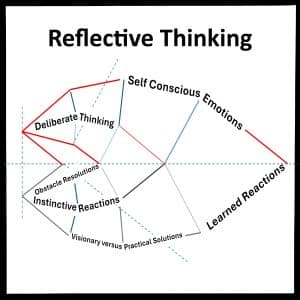
Upon the onset of the conflict in Ukraine, I was instructing several war-affected Ukrainians, and I recognized that each day I was enhancing my own reflective thinking while imparting critical thinking abilities to them. While the world is busy working on artificial intelligence, it may be useful to better understand how human minds work and how, as Marvin Minsky said: “we can start to think about our thoughts themselves and if this reflective thinking shows where we went wrong, that can help us invent new and more powerful ways to think.”
That was the moment I began formulating various curricula that transcended traditional textbooks and better aligned with their existential conditions, their challenges related to conflict, and the looming uncertainty. I recognized that our emotional conditions stem from activating some resources while deactivating others, thereby altering the functioning, perception, and behavior of our brains in response to various situations. The key to comprehending this more effectively is understanding what triggers these resources. What other methods of thinking exist outside our current education, and how may we cultivate multi-dimensional thought processes? I would adapt several classes to accommodate an eighth grader alongside a PhD student candidate, alternating between various cognitive approaches and learning styles. I noted the extent to which students would alter their initial thoughts as we consistently navigated issues across many fields, age demographics, cognitive frameworks, and sometimes cultural and linguistic perspectives.
A fundamental skill I endeavor to teach students at Cambridge Creation Lab is the ability to reframe past behavioral patterns and responses while remaining attuned to their emotional states, since our environments, such as workstations, blackboards, and computers, cannot substitute for our innate cognitive and intellectual processes. While computational devices may excel in some tasks compared to humans, they always lack in other areas; thus, we must include our intuitions, feelings, curiosity, creativity, and logic to varying extents in every decision-making process. This attribute is often overlooked but has immense value across all age groups and professions.