


Uncategorized
Learning from Luis Barragan

Luis Barragan, an architect born in Mexico and recipient of the Pritzker Prize, profoundly influenced the world through his distinctive application of light, shade, shadow, structure, material, and his tactile approach to designing intensely evocative architecture. Luis Barragán spearheaded a collective of Mexican architects who drew inspiration from European functionalist design, endeavoring to amalgamate modernism…
Read MoreCarving Shapes from Imagination

“The playground, instead of telling the child what to do (swing here, climb there), becomes a place for endless exploration, of endless opportunity for changing play. And it is a thing of beauty as the modern artist has found beauty in the modern world.” Isamu Noguchi (1967). Isamu Noguchi, an American artist, furniture designer, and…
Read MoreThoughts on Louis Kahn and Coleridge

“Structure is the giver of light. When I choose an order of structure that calls for column alongside column, it presents a rhythm of no light, light, no light, light, no light, light. A vault, a dome, is also a choice of the character of light. Louis I. Kahn, “Between silence and light.” Louis I. Kahn…
Read MoreSome Thoughts on Gyorgy Kepes

Hungarian artist Gyorgy Kepes dedicated his life to integrating art and science. He became a member of the M.I.T. faculty in 1946. In 1967, he established the Center for Advanced Visual Studies within the School of Architecture to facilitate the integration of new technology as an artistic medium, foster collaboration among artists, scientists, engineers, and…
Read MoreEmbodied Cognition at Cambridge Creation Lab

Embodiment refers to the physical form or manifestation of cognition. It enables intelligent beings—whether artificial or organic—to perceive and alter their environment. It is an active participant that both influences and is influenced by its intellect. Intelligence is the capacity to acquire, retain, and use knowledge. It enables entities to travel, adapt, and modify their…
Read MoreLinkages-Transdisciplinary Perspectives

Linkages are mechanical systems that transform one form of input motion into a different form of output motion. This is accomplished by linking stiff bodies in a manner that retains at least one (and usually precisely one) degree of freedom.A linkage setup is deemed flexible if motion may initiate from that configuration.Articulated mechanical systems, such…
Read MoreHow Can We Weave a Language?

The “language” of knitting patterns and architecture is characterized by their sharing of structure, design, and repetitive features. To generate sophisticated, practical, and appealing solutions, both sectors employ fundamental criteria. These criteria often include attention to detail, functionality, and aesthetic coherence. By intertwining creativity with technical precision, both knitting and architecture can produce works that…
Read MoreImpossible Objects
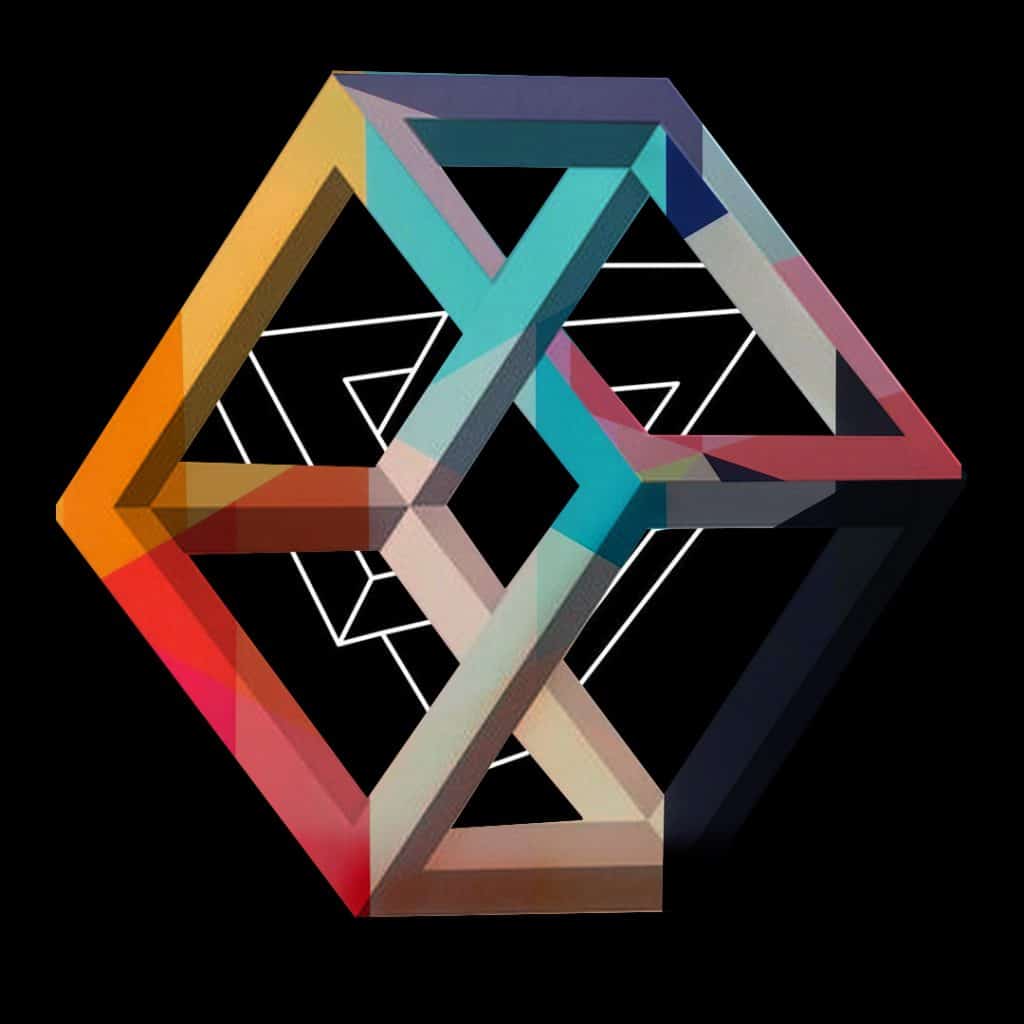
New studies in vision science indicate that visual art frequently deviates from the fundamental principles of physics and is only comprehensible within the context of human consciousness. An example is the Impossible Object, which is also known as an impossible figure or an undecidable figure, and is a kind of optical illusion. It comprises a…
Read MoreTransformative Geometric Forms

Geometric abstract art integrates mathematical forms—such as circles, squares, triangles, and lines—to create structured and aesthetically pleasing compositions. Precision, symmetry, and the interplay between shapes and spaces provide a harmonious equilibrium that captivates observers. Cubism was another influential movement that impacted geometry. Its objective was to deconstruct objects into their geometric components and concurrently depict…
Read MoreReconceptualize Joycean Literature

An analysis of James Joyce’s linguistic play and conceptual engagement with innovative geometric constructions in Ulysses and Finnegans Wake reveals how his topographical depiction of place reflects a shared dilemma between geometric and linguistic modalities of representation. Joyce’s intricate interplay between linguistic creativity and geometric structures reveals a profound exploration of representation, highlighting the tension…
Read MoreFinding Our Visual Language

Shape grammars offer a robust formal framework for the generative characterization of designs. Compared to other generative systems, their distinctive characteristic is that they do visual calculations instead of symbolic computations. Such an approach allows a more intuitive exploration of form and structure, enabling designers to manipulate shapes directly and visually observe the outcomes. As…
Read MoreLived Body Designs

In several sections of his Phenomenology of Perception, Merleau-Ponty, a French phenomenological philosopher, considers habit a significant topic within his philosophical and phenomenological framework. His analysis clarifies the pre-reflexive essence of our initial engagement with the environment and the nature of our body’s understanding in response to it. Merleau-Ponty employs concepts such as the lived…
Read MoreLexical Competency in Young Children

Studies demonstrate that lexical competency substantially influences reading skills and spelling accuracy in elementary school students. This association highlights the need to cultivate vocabulary and linguistic proficiency throughout early childhood. By augmenting lexical competence, educators may enhance early learners’ understanding and overall academic achievement.Reading and spelling are fundamental skills that primary school children develop during…
Read MoreReflections on Synergetics

Synergetics is the foundational discipline underpinning Richard Buckminster Fuller’s concepts of a sustainable future for humanity. Fuller believes in the creativity of human thinking and claims that using the rules of nature in design science can provide enough support for life as the population grows.Synergetics is the term Buckminster Fuller ultimately assigned to his extensive…
Read MoreMaking Thinking Visible- a Habit

An artificial intelligence system that is capable of generating new material, such as pictures, texts, or sounds, generates new content by taking in suggestions in various formats, most often genuine human language. The statistical patterns discovered in massive datasets are used to produce this “new” material, which then results in pictures, text, and media that…
Read MoreSounding Space

Integrating space and sound to create an engaging multidimensional environment is crucial in the creation of a workstation. By combining acoustic design with spatial considerations, workspaces can transcend traditional layouts, inspiring creativity and collaboration. Sound, an imperceptible sensation that traverses space, plays a significant role in shaping our perceptions. It serves as a link between…
Read MoreNegotiating Random Intricacies

The distinction between science and art has always been ambiguous. As we delve deeper into both disciplines, their distinctions often blur, evolving in response to societal shifts and technological advancements. This fluidity highlights the shared creativity inherent in scientific inquiry and artistic expression and emphasizes the value of interdisciplinary approaches in fostering innovation. Ultimately, embracing…
Read MoreWhat Strategies Can We Implement to Promote Learning as a Design Process?

During childhood, exploration is driven by the child’s innate impulses and is shaped by the surrounding environment and available resources throughout developmental stages. The voyage of childhood discovery is a dynamic interplay of innate drives influenced by the environment and developmental stages. Children’s intrinsic curiosity propels them to explore, learn, and invent, highlighting the significant…
Read MoreReframing Elementary School Courses

A fundamental philosophical premise of the theory proposed by Jean Piaget is that children’s thinking will evolve autonomously with age. This ‘autonomous evolution’ refers to the natural, self-driven progression of cognitive development in children, which is not solely determined by external factors but also by the child’s actions and experiences. As children grow, their mental…
Read MoreFluid Patterns In Writing

“I was born cross-eyed. Not until I was four years old was it discovered that this was caused by my being abnormally farsighted. My vision was thereafter fully corrected with lenses. Until four I could see only large patterns, houses, trees, outlines of people with blurred coloring. While I saw two dark areas on human…
Read More